|
|
|
Education for the Whole Brain
Shaun Kerry, M.D.
Diplomate, American Board of Psychiatry and Neurology
The human brain has many parts, but our present educational system only addresses a small percentage of those.
Most of our education today focuses on a narrow segment of the brain, located in the left portion of the cerebral cortex.
Isolating certain parts of the brain does not promote |  | 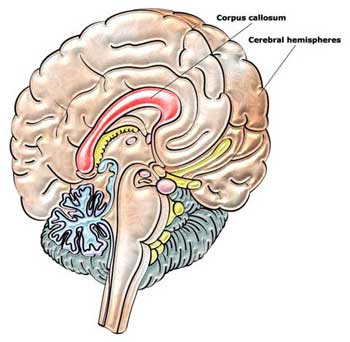 | cohesion: ideally, all parts of the brain should work together.
According to research conducted at the California Institute of Technology during the 1950s, the left side of the brain gives us the ability to analyze, use words, and work with numbers. Conversely, the right side of the brain is responsible for our ability to unify concepts - to put details together resulting in the formulation of a complete picture - and to be creative. Much as people are right or left handed, most people are right or left- brain dominant. Left-brain dominant people are most successful in our current educational system, which limits creativity, and relies mostly upon words and numbers. Our system neglects to consider the needs of right-brain dominant individuals; the 50% of the population that is dubbed "functionally illiterate" by some educators. There are many parts of the brain that do different things, as described in footnote one, but knowing these details is not essential to your understanding of our story. Each brain has a unique personality, which is determined largely at the moment of conception, when egg and sperm join together. This uniqueness entails that every person will require a different educational experience. In our culture, however, these differences are not recognized, and most students are lumped into an educational system that caters to the needs of left-brain dominant individuals. Our society severely neglects the limbic system and the right cerebral hemisphere of the brain. This is very damaging to the development of mindfulness. When the limbic system is excluded from proper stimulation, subjects become dull and lifeless. Emotions and their connection to thoughts are completely ignored; we are constantly given the message to stop feeling. | | 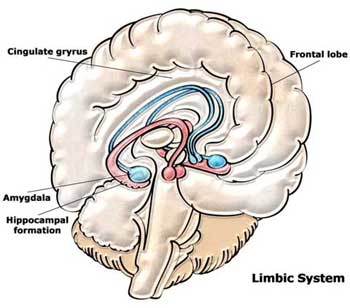 | |
Many people cope with the harshness of society by not showing emotion. As this becomes a habit, emotions are denied altogether. When abuse, forced busyness, or control from external authorities is imposed upon a student, the result is anger, apathy, and an abandonment of the sense of self.
Over time, these feelings become so painful that the brain severs neural connections between the limbic system and awareness. The student, in order to adapt to the pain, unconsciously looses touch with his emotions. |
An animal with its foot caught in a trap will chew its own leg off in order to survive. Similarly, the brain dismembers itself in order to preserve its more basic functions. This enormous loss is dealt with through denial.
During their training, psychotherapists encounter this phenomenon first hand. In most psychotherapy training programs, forced memorization is halted, and the student is asked to assess his true feelings. Usually, the results of this comes as a very disturbing shock. When the soothing effect of denial is removed, the student realizes that he has lost touch with his emotions. By protecting ourselves from pain, we also inhibit ourselves from experiencing heightened degrees of happiness. The loss of such emotions is every bit as severe as the loss of an arm or a leg.
An inevitable byproduct of this process is self-directed anger. Anger directed toward the self results in depression, the occurrence of which has reached epidemic proportions in our culture. Anger directed outwardly results in cruelty, scapegoating, violence, and also epidemics in our society. Footnote 1: Located at the center of our brain is the limbic system, which controls our capacity to form relationships with others. The basal ganglia, large structures deep within the brain, are responsible for our mental activity. Situated near our forehead, the frontal cortex enables us to make judgments and decisions, construct plans, and restrain ourselves from acting on impulse. Furthermore, it ensures that we stay focused and attentive to our tasks. The part called the 'cingulate gyrus,' over the corpus callosum, gives our brain the ability to shift our thoughts from one subject to another. (The word "gyrus" means a convolution.) Below the temple are the temporal lobes, which enable us to remember events, facts, and faces. A large bundle of fibers, the corpus callosum, joins the two sides of the outer shell - cortex - together, and transmits messages from one side of the brain to the other. PRINTABLE PAGE | BACK | TOP | NEXT | PRINTABLE SITE | | |